The King of Sales, Jeffrey Gitomer, once said, “Every customer call is an opportunity.”
Every customer interaction is a business opportunity for you to engage customers, understand their needs, and pitch your product or service to grow your business revenue.
But can you grab these opportunities every time?
What if a customer is trying to call you to connect with your team, but your team is busy with other customers? Maybe 10 or 100 customers call your numbers simultaneously. Who will you serve first?
To solve this problem, businesses simply hire more people for more calling lines, which results in a significant expenditure. But I have an effective solution for you—the IVR System!
In this blog post, we will explain what the IVR system is, how it works, and the benefits of IVR in your business operations. We will also examine how to implement IVR and some common mistakes you should avoid when utilizing the IVR system.
What is IVR?
Interactive voice response (IVR) is software that acts as a virtual receptionist for your contact center. It interacts with customers through voice assistance or manual key inputs. The IVR guides the user through a predefined menu of options and the caller’s input.
How does IVR work?
Customer experience starts with the first word you speak with the customer right after answering the call. But with IVR, you are in control even before the call is answered. Yes, it’s true.
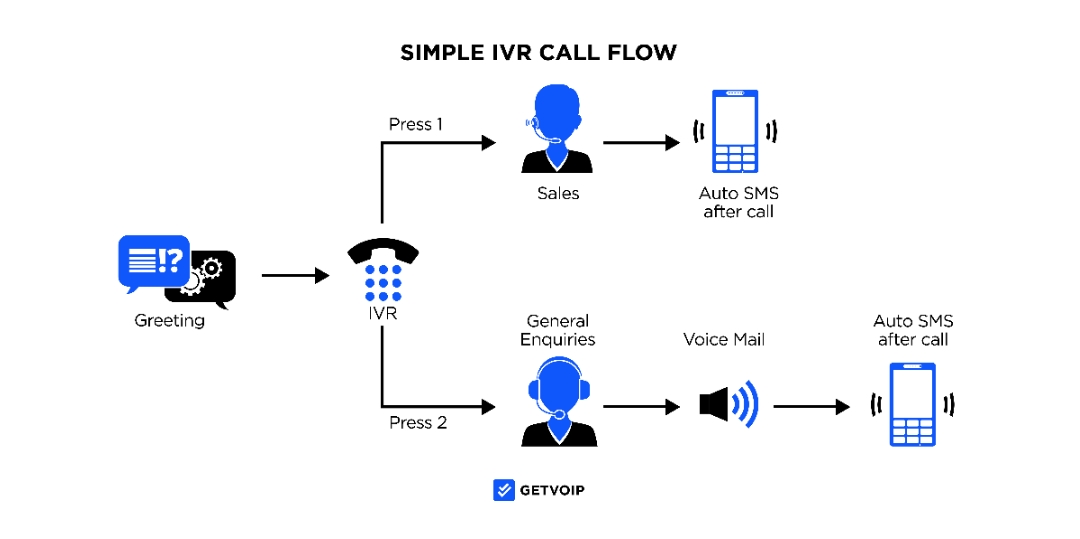
[ Design a similar image for IVR call flow ]
When a customer calls, in the case of a human agent, the IVR system attends the call and greets the customer with a heartwarming welcome message. This eliminates the need to hold customers on busy lines and creates a good first impression for the customer.
Next, the IVR presents a list of options such as product/service information, sales, support representative, product complaints, etc. These options will now be linked with numbers in order. Customers can choose the option they are looking for and press the right key number to select.
If the customer presses key 1, the IVR will provide detailed information about the product or service. Human agents previously did this, but you can automate such routine tasks with the help of IVR software solutions.
You might wonder if there are more choices after the options. Relax; there’s no need to worry. With dynamic IVR, you can have different choices linked to different possibilities. This helps you achieve complete efficiency in automated call handling.
Let me tell you the best part about IVR: It can be a text-based conversation or a voice-assisted conversation. You just need to store your pre-recorded voice messages for the IVR menu, and you are good to go.
If some customers cannot find the option they need, the IVR system will transfer the call line to a human agent so that he can understand the customer query well and quickly resolve the issue.
What Are the Key Features of IVR Systems?
Several important features of IVR systems can significantly improve your customer service operations, which we’ll explore below.
- Automated Call Routing
The IVR system can route the call based on the selection and connect the call to the right agent with the relevant department and skills. This feature helps reduce the need to hold customers and transfer them to another agent repeatedly.
- Multi-Level Menus
When the IVR was introduced, it had only limited features and basic call routing capability. But today, modern IVR software solutions come with multilevel menu options. You can have a number menu linked to more sub-menus to serve the customer efficiently, optimizing IVR implementation.
- Self-Service Options
Customers’ queries usually relate to product information, tracking orders, or account details. IVR systems are the perfect solution to utilize here, letting your agents focus on customers’ real issues by providing a self-service option for information retrieval.
- Voice Recognition & Natural Language Processing (NLP)
Modern IVR solutions are not dependent on a keypad for inputs. They come with the capability to understand voice commands through voice recognition and natural language processing(NLP) technology. Now customers can answer using voice commands, not only the key inputs.
- CRM Integration
CRM integration is one of the exciting features of an IVR system. You can integrate your CRM system with IVR and connect your customer database to make customer interaction more personalized and effective.
- Call Recording & Analytics
The call recording feature allows you to track customer call data performance and use it to improve customer interactions. IVR software solutions with analytics can provide deeper insights into call trends and customer behaviors, enhancing your overall IVR service.
What Are the Key Benefits of IVR for Customer Service?
There are several benefits to having an IVR system in customer service that we will discuss below.
- Reduces Call Wait Times
Traditionally, if the agents are busy with on-call lines, other customers trying to reach the support team must be put on hold. But with the IVR system, it’s different. Customer calls connect with the IVR system, and customers can choose from the available options. If the guided menu does not fulfill the customer’s requirements, they can contact human agents for further help. This helps you automate the call-handling process and reduce the wait times.
- Increases Operational Efficiency
As we just discussed, you can free up your human agents from repetitive tasks by automating them with an IVR software solution. This way, human agents can focus on customers’ real issues and provide better customer service, helping increase customer satisfaction and operational efficiency. By implementing IVR best practices, businesses can streamline routine tasks like providing product information, order tracking, or billing inquiries, allowing agents to handle more complex issues.
- Scales Easily
Suppose you are about to launch your product/service in more geographical areas. As your customer base increases, the pressure on the support team will also increase. So, how will you solve this problem? Will you hire more support staff?
However, with the IVR software solution, you don’t have to do that, and there is no need to increase your operational costs. IVR system can handle a high volume of calls simultaneously. This allows you to scale your customer service operations as your customer base grows without making additional investments.
Whether you’re implementing IVR for customer service or expanding your business globally, an IVR system enables you to manage increased demand without compromising on service quality. With the right IVR implementation, your business can ensure that every customer interaction is smooth and effective, even as volumes rise.
- Cost Savings
The IVR software can automatically handle all routine and repetitive tasks that human agents must perform manually. Customers will get all the information they want through IVR, eliminating the follow-up process. Thus, you can now reduce the human resources needed for your customer service and operational costs.
4 Common IVR Implementation Mistakes and How to Avoid Them
Although an IVR system has many benefits for businesses, they fail to fully utilize it effectively. Companies may make some common mistakes while implementing an IVR system. Here are some you should care about.
- Overcomplicated Menu Options
Sometimes, businesses fail to optimize the IVR menu and create a long list of unnecessary options. Too many choices can overwhelm callers, and the longer wait times can frustrate them. Customers may struggle to navigate the complex menu options, leading to disconnecting the call in frustration.
How to avoid: Keep the overall structure of the IVR menu simple and logical. Group similar options and choices and use clear, concise menu options. This is a key part of IVR best practices, ensuring that your IVR service offers a smooth and intuitive experience. A well-designed IVR call flow can significantly improve efficiency and reduce call abandonment.
- Lack of Live Agent Support
Usually, In the IVR menu, the option to speak with the human agent is at the last or may be difficult to reach easily. Now, if a customer directly wants to talk with a live agent, they may get frustrated with the initial more extended menu option, which creates a negative customer experience.
How to avoid: Always provide an easy-to-find “talk to an agent” option within the first few menu choices. Use AI-powered call routing to direct urgent inquiries to the right department.
- Poor Voice Recognition
Some IVR solutions rely on voice recognition technology that struggles to understand different accents, speech patterns, or background noise. This leads to repeated errors, requiring customers to repeat themselves multiple times, which can be highly frustrating.
How to avoid: Invest in advanced AI and machine learning technologies to enhance voice recognition accuracy. AI-driven IVR can adapt to different speech patterns, improving the user experience.
- No Personalization
A generic IVR experience can feel impersonal and robotic. Customers appreciate when a system recognizes their past interactions, account details, or preferences. A lack of personalization makes interactions feel disconnected and inefficient.
How to avoid: Implement AI-driven IVR solutions that enable personalization. Use caller ID to recognize repeat customers, offer menu options, and provide relevant information based on previous interactions.
In Summary,
An IVR software solution is a smart way to handle customer calls without long wait times or extra costs. It helps businesses manage calls better, provide self-service options, and quickly connect customers to the right person.
By avoiding the common mistakes in the IVR implementation we discussed, you can make the system easy to use and more helpful for your customers. Avoid common mistakes like confusing menus or hard-to-reach live agents to keep your customers happy.
A well-planned IVR system can improve customer service, save time, and help your business grow smoothly.